Claude API pricing (October 2026): what it costs and how to estimate your bill
The Claude API bills per million tokens. As of Oct 19, 2026: Opus 5.5 is $4 input / $20 output, Sonnet 5.5 $2 / $10, and Haiku 5.5 from $0.10 / $0.50.

On this page
The Claude API charges per million tokens (MTok), with separate rates for input and output. As of Oct 19, 2026, Claude Opus 5.5 is $4 input / $20 output per MTok, Claude Sonnet 5.5 is $2 / $10, and Claude Haiku 5.5 starts at $0.10 / $0.50. The Batch API halves those rates, and cached prompt reads cost a fraction of normal input.
Prices as of Oct 19, 2026, from Anthropic's official pricing page (external). All prices USD. Anthropic updates prices; check that page before you budget.
By Gary, Greenlight · Drafted with AI tools and reviewed before publishing.
Claude API price per model (selected)
| Model | Input / MTok | Output / MTok | Cache read / MTok | Batch input / output |
|---|---|---|---|---|
| Claude Opus 5.5 | $4 | $20 | $0.20 | $2 / $10 |
| Claude Opus 5 | $5 | $25 | $0.50 | $2.50 / $12.50 |
| Claude Sonnet 5.5 | $2 | $10 | $0.10 | $1 / $5 |
| Claude Sonnet 5 | $2 | $10 | $0.20 | $1 / $5 |
| Claude Sonnet 4.6 | $3 | $15 | $0.30 | $1.50 / $7.50 |
| Claude Haiku 5.5 (prompts up to 100K tokens) | $0.10 | $0.50 | $0.01 | $0.05 / $0.25 |
| Claude Haiku 5.5 (prompts over 100K tokens) | $0.50 | $2.50 | $0.05 | $0.25 / $1.25 |
| Claude Haiku 4.5 | $1 | $5 | $0.10 | $0.50 / $2.50 |
Anthropic lists more models (including larger and limited-availability ones) on its pricing page. A note there says Sonnet 5's $2/$10 launch price is now the standard price. Anthropic's models overview suggests starting with Claude Opus 5.5 if you're unsure which model to use.
What's a token?
A token is a chunk of text. Anthropic notes that Claude 4.7 and later models use a newer tokenizer that produces about 30% more tokens for the same text, so the same prompt can use more tokens on newer models. Use Anthropic's token counting to measure your real prompts.
Worked examples
Say your app handles 1,000 requests, each with 2,000 input tokens and 500 output tokens. That's 2 MTok input and 0.5 MTok output.
| Model | Input cost | Output cost | Total |
|---|---|---|---|
| Haiku 5.5 | 2 × $0.10 = $0.20 | 0.5 × $0.50 = $0.25 | $0.45 |
| Sonnet 5.5 | 2 × $2 = $4.00 | 0.5 × $10 = $5.00 | $9.00 |
| Opus 5.5 | 2 × $4 = $8.00 | 0.5 × $20 = $10.00 | $18.00 |
Same job on the Batch API (Sonnet 5.5): 2 × $1 + 0.5 × $5 = $4.50, half the standard price, if you can wait for results.
With prompt caching (Sonnet 5.5): suppose 1,500 of each request's 2,000 input tokens are a shared system prompt read from cache. Cached input: 1.5 MTok × $0.10 = $0.15. Uncached input: 0.5 MTok × $2 = $1.00. Output: $5.00. Total ≈ $6.15, plus the cache write (1.25× base input for a 5-minute cache). These are illustrations from list prices, not quotes.
Other things that change your bill
- Prompt caching: a 5-minute cache write costs 1.25× base input, a 1-hour write 2×, and a read 0.1× on most models (0.05× on Opus 5.5 and Sonnet 5.5).
- Batch API: 50% off input and output for asynchronous jobs.
- Long prompts on Haiku 5.5: requests over 100,000 prompt tokens pay the higher rates in the table.
- Web search tool: $10 per 1,000 searches, plus tokens.
- US-only inference (
inference_geo: "us") on Claude 4.6 and later models: 1.1× all token prices. - Fast mode on some Opus models costs more (for example, Opus 5.5 fast mode is $8 / $40 per MTok).
- Free credits: Anthropic says new users get a small amount of free credits to test the API.
What about Claude Code pricing?
Per Anthropic's pricing page (external), as of Oct 19, 2026, Claude Code is included in all paid Claude plans and shares the plan's usage limits with chat. Pro is listed at $20 a month billed monthly ($17 a month with the annual discount), and Max starts at $100 a month. For heavy sessions, Anthropic says you can switch to pay-as-you-go API credits through a Console account, billed at the API rates above.
How to keep Claude API costs under control
- Pick the smallest model that does the job. Anthropic's own advice: Haiku for simple tasks, Sonnet for most production work, Opus for the most complex reasoning.
- Cache long, repeated prompts.
- Batch work that isn't urgent.
- Cap output length with
max_tokens. - Set spend limits in the Console, and watch your usage.
- Protect your key. A leaked key spends your money. See Claude API key security and our Supabase service role key rotation guide for the rotation pattern.
FAQ
How much does the Claude API cost? It's per million tokens and depends on the model. As of Oct 19, 2026: Opus 5.5 $4/$20, Sonnet 5.5 $2/$10, Haiku 5.5 from $0.10/$0.50 (input/output per MTok). Check Anthropic's pricing page for current rates.
Is the Claude API free? Anthropic says new users get a small amount of free credits to test it; after that, usage is billed.
Is Claude Code included in a Claude subscription? Per Anthropic's pricing page, Claude Code is included in all paid plans and shares the plan's usage limits. API usage through a Console account is billed separately at API rates.
What's the cheapest way to use Claude via API? Use the smallest model that works, cache repeated prompts and use the Batch API for non-urgent jobs.
Do output tokens cost more than input tokens? Yes. On the models listed above, output is 5× input.
What does Greenlight's free scan check?
From the outside only: HTTPS, security headers, exposed .env and .git files, public source maps, and common secret key patterns in your homepage's scripts, including Anthropic and OpenAI API key formats. If it finds a Supabase project and its public key there, it counts which tables return rows to that public key (it reads no row data). It doesn't log into your builder or Supabase, read your code repository or RLS policies, or test logins and app logic, and "nothing found" isn't a guarantee.
Sources
On this site
Related posts
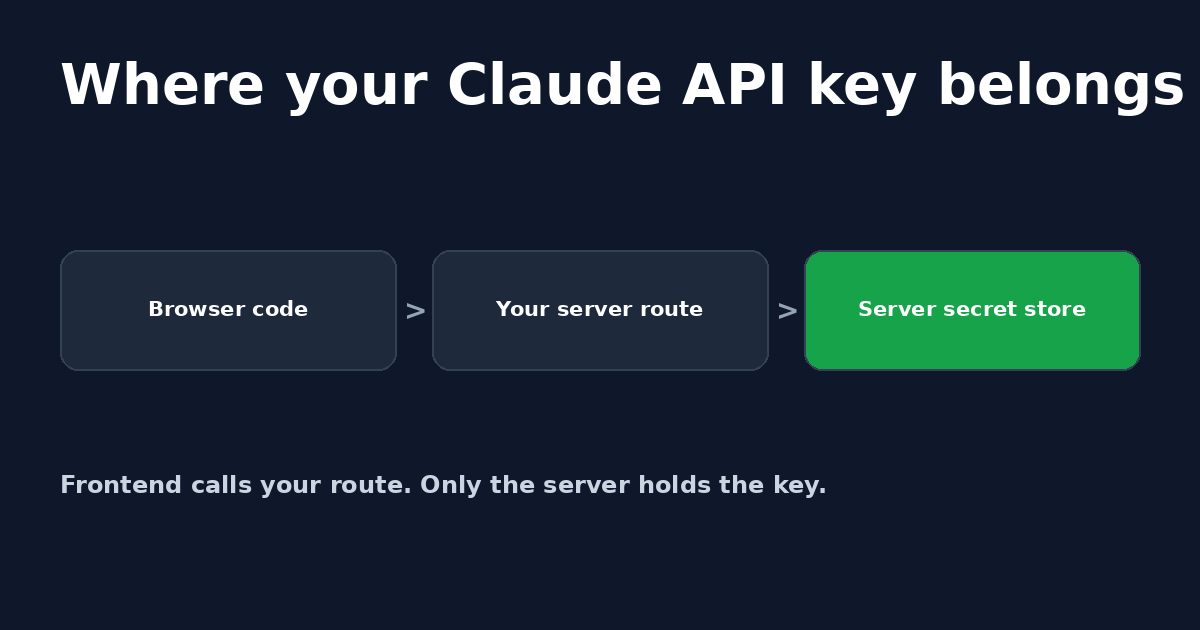
Claude API key security: how to keep your Anthropic key safe
A Claude API key works like a credit card for your Anthropic account. Where to store it, why it never belongs in frontend code, and what to do if it leaks.
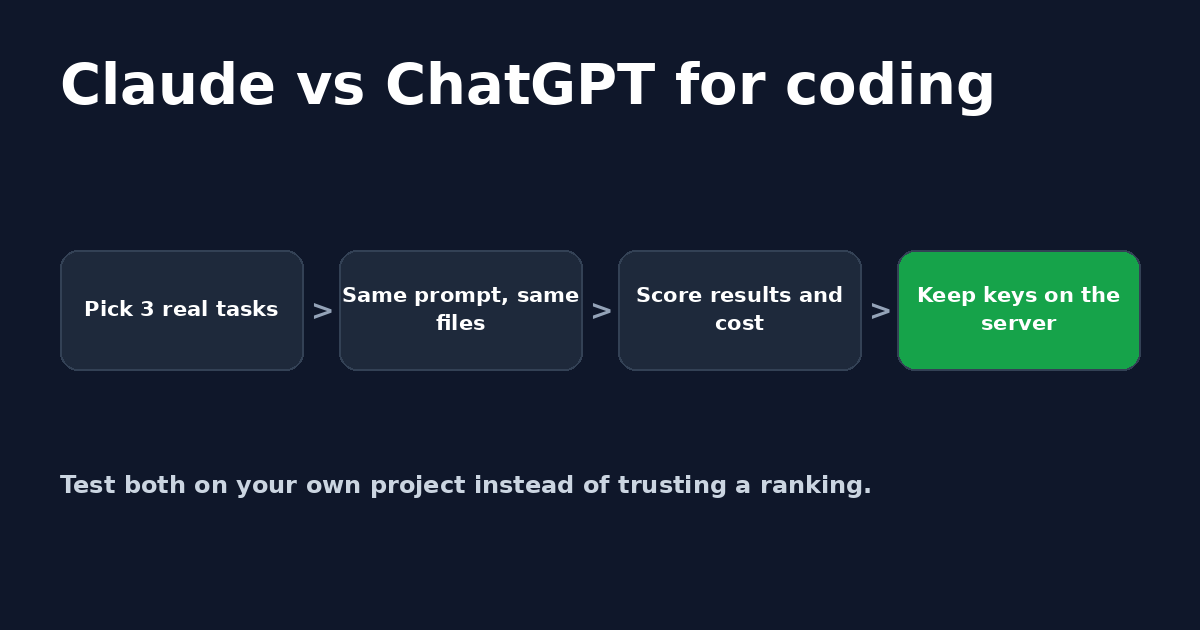
Claude vs ChatGPT for coding: which fits your workflow?
Claude vs ChatGPT for coding, compared on verified facts: API prices, context windows and coding agents (Claude Code vs Codex), plus how to test both.


Greenlight is independent and not affiliated with or endorsed by Anthropic, Claude, Claude Code or Supabase. Product names are used only to identify the tools this guide is about. Prices are Anthropic's published list prices as of Oct 19, 2026 and can change; check Anthropic's pricing page before you budget. This page is general information, not professional security advice, legal advice, a security audit or a guarantee. Check your own setup against the vendor's current docs.